

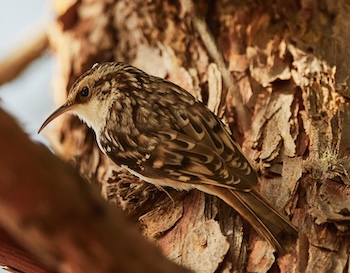
A Brown Creeper. Photo by Frank D. Lospalluto.
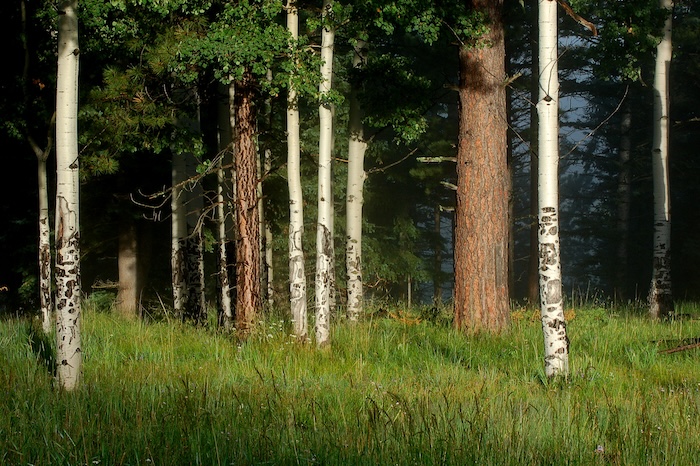
The mixed-conifer forests of the American southwest have long been on the edge- the region is the southern edge of the range for many of the tree species that characterize these forests. But a warming climate and a megadrought that has now stretched more than two decades may be starting to push them, and the bird species that inhabit them, over that edge. Higher temperatures and less water cause physiological stress that makes trees less likely to survive beetle outbreaks. These conditions also increase the severity and frequency of wildfires. The resulting tree mortality leads to changes in forest structure and composition- or loss of forest entirely. So it's no surprise that populations of many bird species that use this habitat are declining in the southwest. Mixed-conifer forest species like Pine Siskin, Dark-eyed Junco, Dusky Grouse, and Brown Creeper have seen rapid population declines estimated at 20% or more in just a decade in Arizona. These species may be considered abundant in other regions, but many are now considered Species of Greatest Conservation Need in Arizona and New Mexico.
In a study published this past March in Forest Ecology and Management, IBP’s Southwest Avian Ecologist Harry Jones, Quantitative Ecologist Brandon Merriell, Executive Director Rodney Siegel, and co-authors from the National Park Service’s Southern Colorado Plateau Network, used the Network’s monitoring data on breeding-bird densities along with vegetation structure and composition in Bandelier National Monument and Grand Canyon National Park to examine which changes in mixed-conifer forests affect the populations of 34 bird species that inhabit them. A better understanding of these relationships will help land managers manage these forests and conserve bird populations more effectively in the face of drought and wildfire.
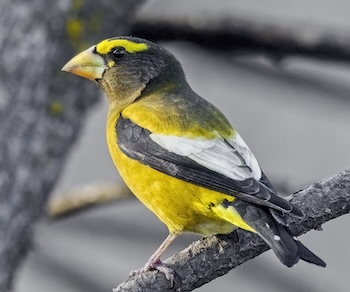
A male Evening Grosbeak. Photo by Patrick Dirlam.
The monitoring data used in this study spanned 11 years (2008-2018), but the parks were not surveyed every year. Bandelier was monitored in 2008, 2009, 2012, 2015, and 2018, while Grand Canyon was monitored 2011, 2014, and 2017. The high severity Las Conchas fire in Bandelier in 2011, and a prescribed fires applied in Grand Canyon in 2012, provided the researchers an opportunity to examine the effects of fire on bird populations through changes to their microhabitats. A wide variety of bird species were included in the study, from aerial insectivores, nectivores, seed-eaters, and bark foragers (e.g. woodpeckers and nuthatches), to cavity and ground nesters, migrants, and year-round residents. Vegetation surveys measured 12 characteristics that are expected to change with drought and wildfire, including canopy cover, foliage height diversity, sapling density, tree basal area (a proxy for tree age and size) and tree species richness.
Bird responses to changes in mixed-conifer forests were, aptly, mixed. “It was actually remarkable how there were no vegetation variables that were associated with more than a third of the species we modelled,” says Jones. And the responses to those variables were also mixed, with some species increasing in density in response to a given variable while others decreased.
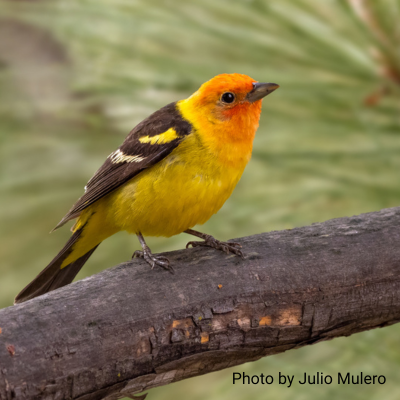
The high-severity Las Conchas fire at Bandelier led to changes in both the tree and the bird species present. Densities of 32% of modelled bird species, including Hermit Thrush and Evening Grosbeak, declined, while densities of others (17% of modelled species), including Olive-sided Flycatcher and Green-tailed Towhee, increased following the fire. Some of the species that increased, like Northern House Wren and Western Wood-pewee, are not generally considered post-fire specialists and these results suggest that some Southwestern mixed-conifer forest birds may benefit from, or at least be resilient to, moderate to high-severity wildfire disturbance. But there is a caveat- the burned area was only surveyed in the 2018 monitoring effort. “I think it is important to emphasize that the post-fire results are a brief snapshot of how birds responded to the wildfire,” says Jones. “If we had sampled two years earlier or later we might have seen different results as the time since fire is an important determinant of which species are present.”
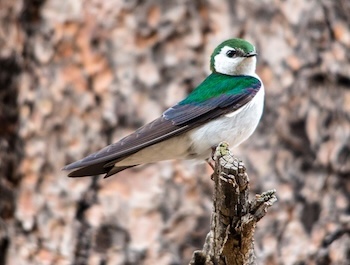
A Violet-Green Swallow. Photo by Jacob W. Frank
Breeding bird density varied in response to each of the vegetation structure variables that were measured. Canopy cover and the layers of foliage beneath the canopy were important for some species. The mixed-conifer forests in the study exhibited a wide range of canopy cover (from 5 to 95%), and 13 bird species responded to this variable. But over 60% of the study species did not appear to change in relation to canopy cover. Jones found this result surprising. “Maybe mixed-conifer birds are adapted to use more open forests than those that currently exist”, says Jones, “or they are responding to other specific habitat elements.” Beneath the canopy, several species seemed to prefer more subcanopy foliage (e.g., Yellow-rumped Warbler) and foliage at a variety of heights (e.g., Orange-crowned Warbler.)
Another structural aspect of the forest- the size of trees- influenced breeding bird density. About a third of species in the study declined in density as sapling density increased, indicating a preference for mature trees. On the other hand, just over a third of species declined in density as tree basal area increased (larger, older trees have greater basal area), which suggests that this subset of species (which included species associated with both early and late successional habitat) benefits from some disturbance. The researchers suggest that this pattern does not show a preference for old vs. young forests but rather avoidance of infilled forests (more crowded with an influx of white and Douglas fir after fire suppression) and undisturbed climax communities.
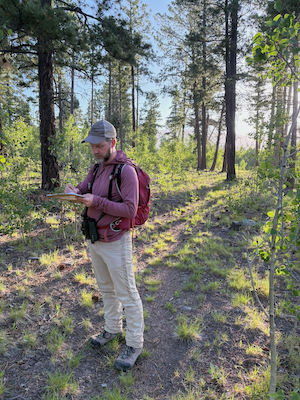
Southwest Avian Ecologist Dr. Harry Jones conducting a point count in Bandelier National Monument in 2025. Bird monitoring efforts in both Grand Canyon and Bandelier continue, yielding important data that will help the National Park Service conserve birds in the parks.
The species of trees that make up the forest also matter to birds. About a third of the bird species showed increased density at sites with a greater number of tree species present, but none showed increased density when fewer tree species were present. Several species, including Violet-green Swallow and American Robin, were present in greater densities when more mesic tree species like Engelmann’s spruce and subalpine fir dominated the forest. But other species including White-breasted Nuthatch and Green-tailed Towhee appeared to prefer forest dominated by more xeric tree species like white fir and ponderosa pine.
“Taken together, these results indicate that the indirect effects of climate change, which is to say our current megadrought and the increased frequency of wildfire we are seeing on the landscape, have real potential to contribute to population declines of mixed-conifer forest birds, both by changing the structure of the habitat, and by changing the tree species composition of our forests,” says Jones. “While a lot of these birds are common nationally, populations of many species in Arizona and New Mexico have plummeted in the last decade, and this paper provides mechanisms for those declines.”
This study also suggests ways to mitigate those declines. The contradictory nature of the bird responses, with some species showing positive associations with a given vegetation characteristic while an almost equal number show a negative association with it, demonstrate that one forest structure or composition does not fit them all. Land managers can use disturbance like prescribed fire or thinning to create a mosaic of different forest structures and tree species compositions that will help support the full suite of southwestern mixed-conifer forest bird species across broad landscapes.